
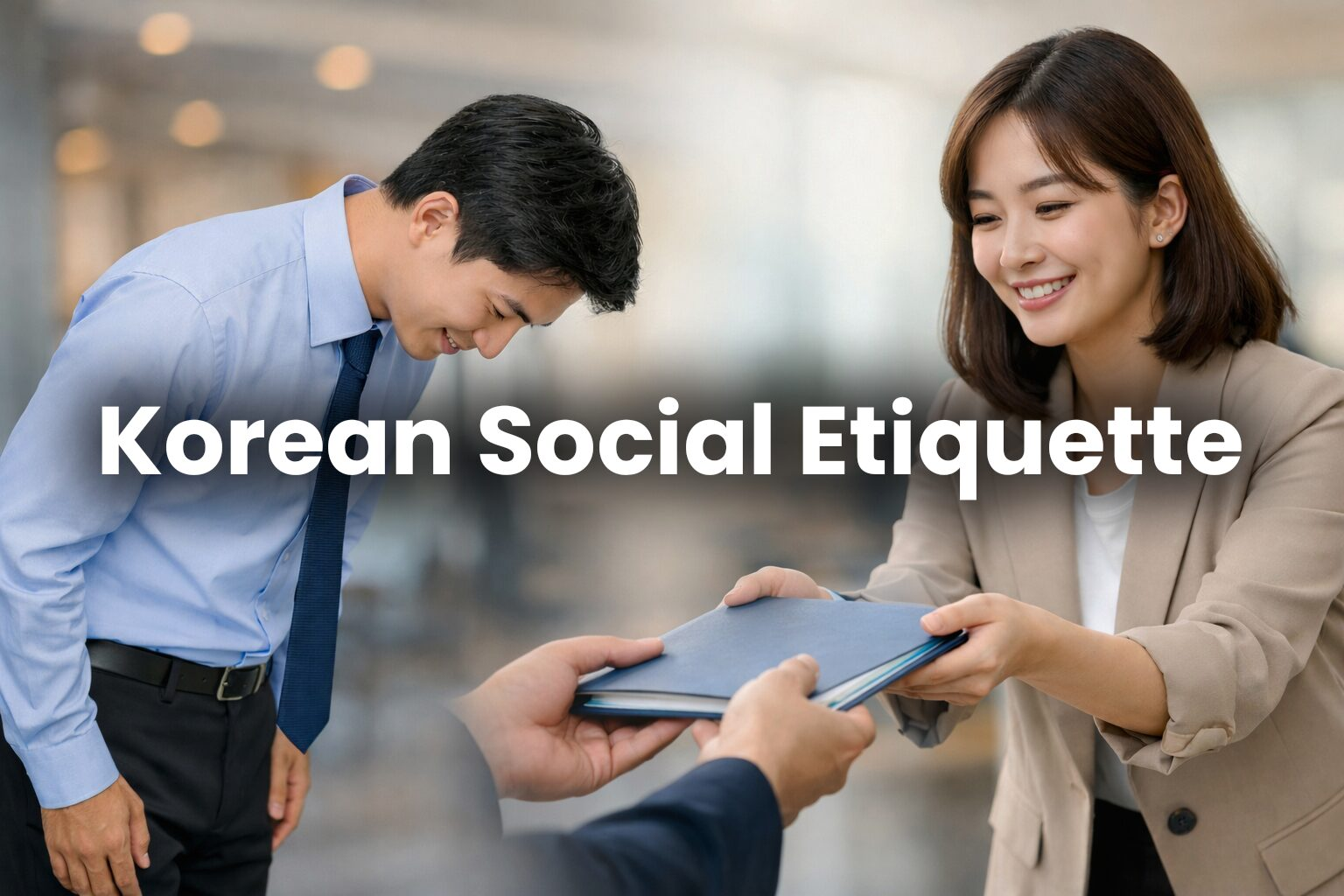
If you live in Korea, work here, or spend time in Korean communities, you’ve probably noticed cultural differences at some point.
When Korean culture still feels unfamiliar, it’s easy to find yourself in awkward situations—or make small mistakes without meaning to.
The good news is that most Koreans understand you’re a foreigner and usually try to be patient and understanding.
In this post, I’ll walk you through five common social mistakes foreigners make in Korea, especially when they’re not yet familiar with some of Korea’s unspoken cultural norms.
If you’re working in Korea or interacting with Korean coworkers, this guide may be especially helpful.
Let’s get started!
1. Greeting with Hands Pressed Together 🙏
If you’ve ever seen Hollywood actors visiting Korea for movie promotions, you may have noticed some of them greeting people with their hands pressed together.
However, this is not a Korean greeting.
(And no—pressing your palms together is not a universal greeting across all Asian countries.)
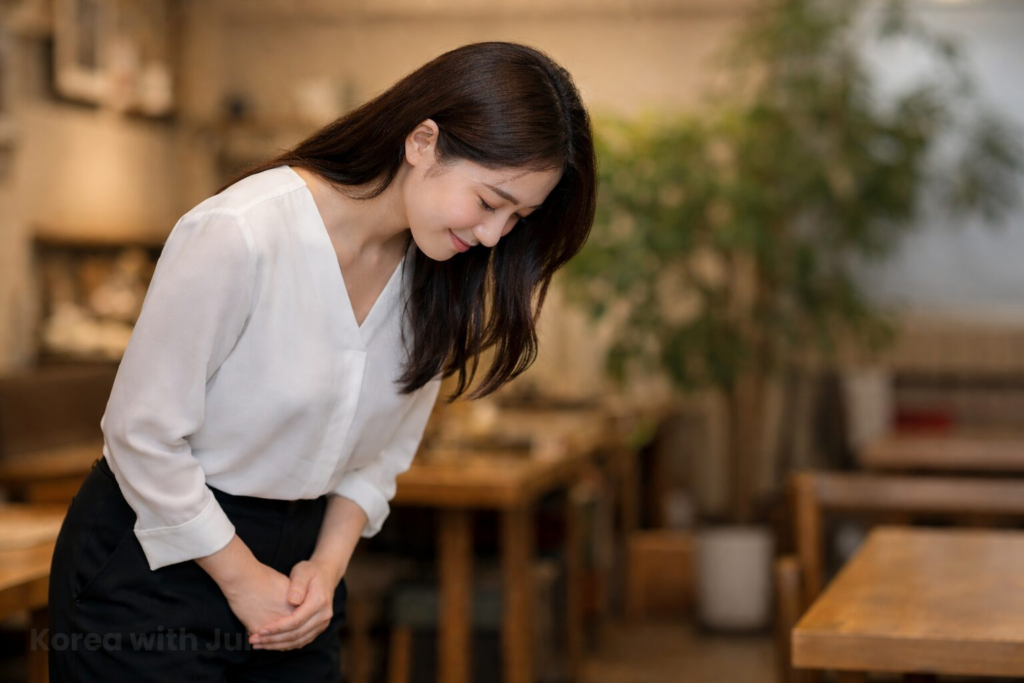
In Korea, people greet each other with a small bow, known as moknye (목례).
This usually involves slightly lowering your head or upper body.
The depth of the bow depends on age, hierarchy, and the situation:
- About 15 degrees – casual greetings in elevators, shops, or office hallways
- About 30 degrees – greeting a superior, meeting someone older for the first time, or formal situations
- 45 degrees or more – apologies, expressing deep gratitude, or very formal occasions
Of course, you don’t need to calculate the exact angle in your head.
The more respect you want to show—or the more serious the situation—the deeper the bow.
2. Using “How Are You?” as a Greeting
There isn’t a direct Korean equivalent to “How are you?” used as a casual greeting.
In Korea, people don’t usually ask about someone’s feelings or how they’re doing as part of a standard hello.
Instead, most greetings are simply:
- “안녕하세요” (Annyeonghaseyo)
- “안녕” (Annyeong) for casual situations
That said, Koreans do have a unique way of asking about someone’s well-being.
You’ll often hear:
- “밥 먹었어?” (Did you eat?)
- “식사 하셨어요?” (Have you eaten?)
Translated directly, it sounds like “Did you have a meal?”
Which can feel a little strange at first—why ask about food out of nowhere?
Historically, Korea was an agricultural society that experienced frequent famines and wars.
Being able to eat meant being safe and getting through the day.
So asking whether someone has eaten became another way of saying, “Are you okay?” or “Did you get through today safely?”
Even today, food and meals are deeply important in Korean culture, which is why so many Korean expressions revolve around “bap” (밥)—a word that can mean both rice and a meal.
So if a Korean asks whether you’ve eaten, don’t panic.
If you have, just say you did. If you haven’t, say you haven’t.
(If you say you haven’t eaten yet, you may notice a look of genuine concern on their face. LOL)
3. Giving or Receiving Things with One Hand
In Korea, unless you’re very close friends with someone, it’s polite to use both hands when giving or receiving items.
This is especially important when:
- you don’t know the person well
- interacting with a superior or someone older
- handing over a credit card at a shop
- receiving alcohol from an elder
- exchanging important documents
- exchanging business cards
If you use just one hand, most Koreans will understand that you’re a foreigner.
But if you use both hands, it leaves a strong impression that you’re polite and culturally aware.
This matters even more if you’re working in Korea—small gestures like this go a long way in professional settings.
4. Toasting with Your Left Hand
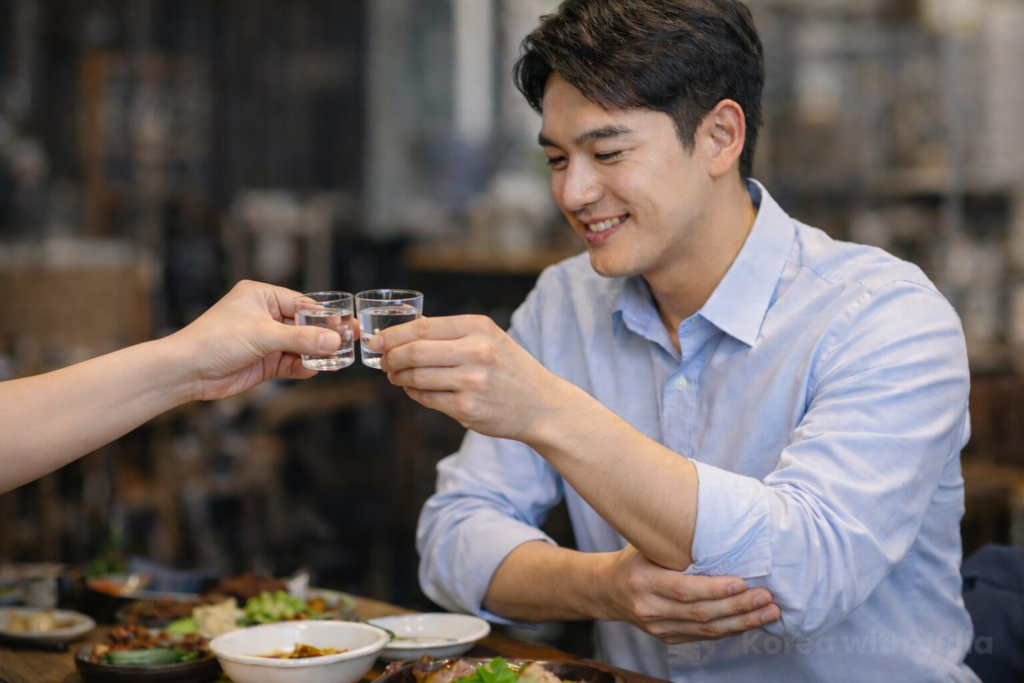
In Korea, you should hold your glass with your right hand when making a toast.
Using your left hand—especially when drinking with elders or superiors—can come across as ignoring formality.
When drinking with someone senior, it’s also polite to:
- slightly turn your head away when taking your first sip after clinking glasses
- avoid making direct eye contact while drinking
You don’t need to hold your glass with both hands when making a toast, but it’s polite to support your right arm with your left hand.
(The same posture can also be used when receiving a drink.)
Other common drinking etiquette includes:
- not refilling your own glass
- waiting for someone else to pour for you
- making sure the other person’s glass is empty before pouring
- joining the toast even if you’re not drinking alcohol
These rules are more important during company dinners or work-related gatherings.
When drinking casually with close friends, things are generally much more relaxed, so you don’t need to be as formal.
5. Sitting in the Seat of Honor
In Korea, the concept of a seat of honor applies not only to formal events, but also to everyday situations—restaurants, meetings, cars, and even taxis.
In simple terms, seating has an order.
Certain seats are traditionally reserved for elders, superiors, or guests.
If you work in Korea and aren’t in a senior position, it’s important to be aware of where those seats are.
At restaurants or company dinners
- the seat farthest from the entrance
- inner or wall-side seats
In meeting rooms or offices
- the center of the table
- the seat farthest from the door
- seats with the best view of presentation screens
At long dining tables
- inner seats near the center
- positions closer to the middle rather than the edges
In taxis or cars
- the rear right seat (behind the passenger seat)
At formal events
- front seats
- usually assigned with name cards, so confusion is rare
It’s also polite to wait until senior people sit first.
If you’re unsure where to sit, follow the youngest person’s lead or choose a seat near the entrance to be safe.
Cultural Mistakes Aren’t About Being Rude
Most social mistakes foreigners make in Korea don’t come from being rude.
They usually come from applying one cultural standard to a different context.
You don’t need to memorize every rule or get everything right.
Even Koreans interpret etiquette differently depending on the situation and generation.
What truly matters is your attitude—being respectful, observant, and staying open to learning.
Pausing for a moment, watching what others do, or simply asking, “Is this the right way to do it?” is usually more than enough to smooth over most situations.
I hope this guide gives you a few helpful insights and makes daily life in Korea feel a little easier. 🇰🇷✨
Leave a Reply