
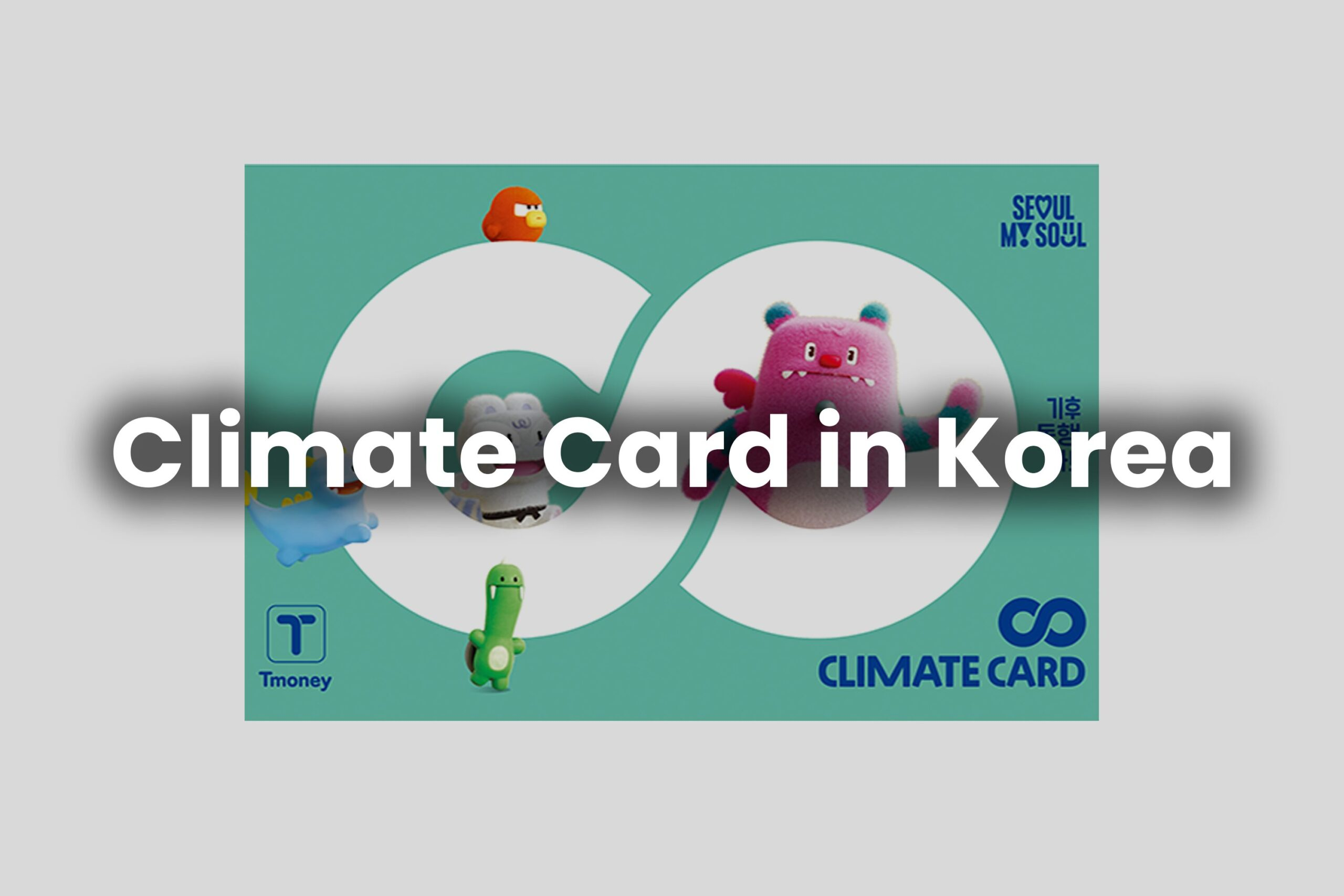
There’s more than one transit card you can use on public transportation in Korea. T-money isn’t your only option.
If you live in Seoul—especially if you’re a foreign resident who uses buses and subways every day—this card might actually be a better choice than a regular T-money card.
It’s called the Climate Card (기후동행카드), Seoul’s unlimited public transit pass.
The Climate Card is an integrated transit pass that allows unlimited rides on public transportation for a fixed period with a single payment.
The policy was designed to reduce transportation costs for residents and encourage less reliance on private cars, helping to lower carbon emissions.
Launched as a pilot program in 2024, the Climate Card received strong public support and is still actively in operation as of 2026.
Now, let’s take a closer look at how it works!
Related Post
Your First Korean Transportation Card: How to Buy and Charge a T-money Card (2026)
What Transportation Can You Use with the Climate Card?
The Climate Card can be used on the following transportation options within Seoul:
- Subways
- Buses
- Hangang Bus
- Ttareungi (Seoul’s public bike system)
However, transportation outside Seoul is generally not covered.
This includes:
- Subways outside Seoul
- Intercity buses connecting Seoul and Gyeonggi-do
- Airport buses
- Buses licensed in other regions
Although parts of the Shinbundang Line and GTX run through Seoul, these lines are not covered by the Climate Card.
For example, if you take Line 1 from Seoul Station to Suwon Station, the Climate Card cannot be used because you exit outside the covered area.
If you accidentally tag your Climate Card in this situation, station staff will charge an additional fare at the exit gate.
Exceptions: Where the Climate Card Still Works
There are a few exceptions where the Climate Card can be used even outside Seoul.
1. Seoul-Licensed Buses
If a bus is licensed in Seoul, the Climate Card can be used even if you get off outside Seoul.
You can check whether a bus is registered in Seoul using the Seoul Bus Information System (BIS).
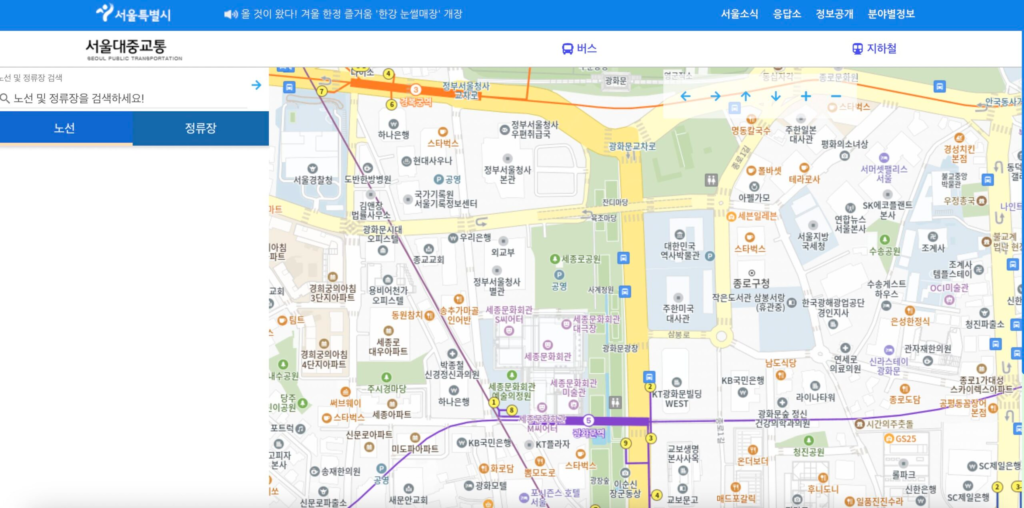
Since this website is only available in Korean, it helps to remember a few labels.
For example, if you search for bus number 720, you’ll see results like this:
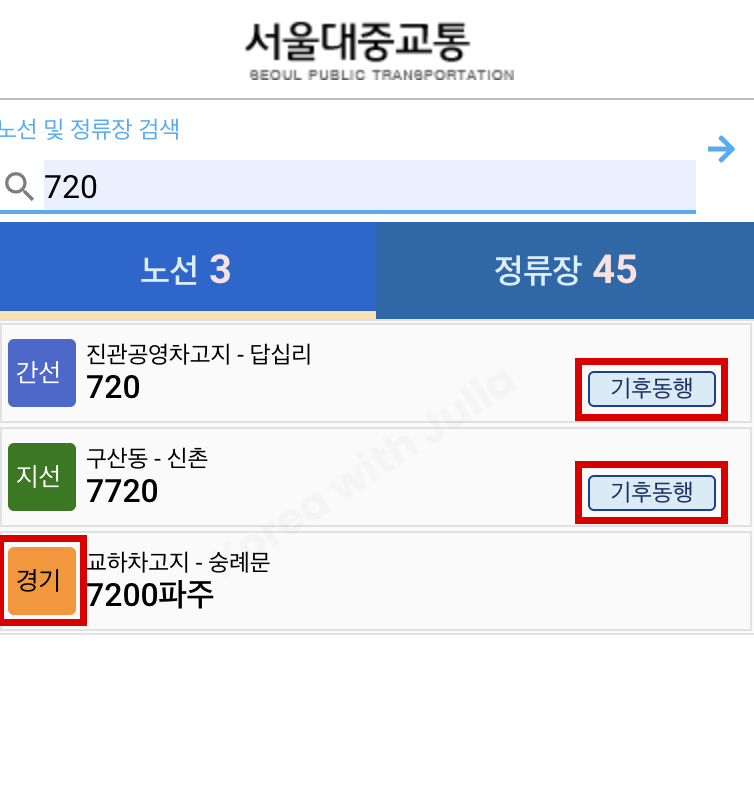
- A yellow “경기” label means the bus is licensed in Gyeonggi-do, not Seoul.
- A light-blue “기후동행” label means the Climate Card is accepted.
2. Certain Gyeonggi-do Subway Sections
While the Climate Card usually applies only to subway trips within Seoul, it also covers certain sections in Gyeonggi-do.
That said, the Shinbundang Line and GTX are still excluded.
Below is a list of subway lines and station sections where the Climate Card is accepted (as of January 2026).
| Line | Covered Section(s) | Line | Covered Section(s) |
|---|---|---|---|
| Line 1 | Onsu – Dobongsan Geumcheon-gu Office – Dobongsan | Ui–Sinseol Line | Entire line |
| Line 2 | Entire line | Sillim Line | Entire line |
| Line 3 | Entire line | AREX (Airport Railroad Express) | Gimpo Airport – Seoul Station |
| Line 4 | Government Complex Gwacheon – Jinjeop | Gyeongui–Jungang Line | Tanhyeon – Seoul Station Guri – Seoul Station |
| Line 5 | Entire line | Gyeongchun Line | Cheongnyangni – Sinnae |
| Line 6 | Entire line | Suin–Bundang Line | Cheongnyangni – Ori |
| Line 7 | Onsu – Jangam | Gimpo Gold Line | Entire line |
| Line 8 | Entire line | Gyeonggang Line | Pangyo – Imae |
| Line 9 | Entire line | Seohae Line | Ilsan – Gimpo Airport |
3. Two Special Cases of Getting Off Outside the Coverage Area
There are two routes where the Climate Card can still be used even if you get off at a station outside the coverage area, as long as you board within the covered area.
- Line 7: Seoknam – Kkachiul section
- AREX: Incheon Airport Terminal 1 – Terminal 2 section
For example, if you board in Seoul Station and get off at Incheon Airport Terminal 1, the Climate Card is valid.
However, you cannot use the Climate Card when boarding on these sections.
Climate Card Prices
The Climate Card is period-based.
It comes in:
- Short-term passes: 1, 2, 3, 5, or 7 days
- Monthly pass: 30 days
If you’re visiting Korea as a tourist, simply choose a short-term pass that matches your itinerary.
If you live in Seoul and commute daily for work or school, the 30-day pass is far more cost-effective.
For the 30-day pass, there are four options depending on what you want included:
- Subway + Bus
- Subway + Bus + Ttareungi (public bike)
- Subway + Bus + Hangang Bus
- Subway + Bus + Ttareungi + Hangang Bus
Short-term passes only cover subways and buses. Bikes and Hangang Bus are not included.
30-Day Pass Prices (as of January 2026)
| Type | Regular Price | Youth Discount Price (Ages 13–39) |
|---|---|---|
| Subway + Bus | ₩62,000 | ₩55,000 |
| Subway + Bus + Ttareungi (Public Bike) | ₩65,000 | ₩58,000 |
| Subway + Bus + Hangang Bus | ₩67,000 | ₩60,000 |
| Subway + Bus + Ttareungi (Public Bike) + Hangang Bus | ₩70,000 | ₩63,000 |
* Teens (13–18) and young adults (19–39) receive a ₩7,000 discount.
* To receive the youth discount, you must register your date of birth on the T-money website—just like with a regular T-money card.
Short-Term Pass Prices (as of January 2026)
| Duration | Price |
|---|---|
| 1-Day Pass | ₩5,000 |
| 2-Day Pass | ₩8,000 |
| 3-Day Pass | ₩10,000 |
| 5-Day Pass | ₩15,000 |
| 7-Day Pass | ₩20,000 |
How to Buy and Top Up the Climate Card
The Climate Card comes in two formats: a physical card and a mobile card.
Personally, I recommend the physical card.
This is because the mobile version only works on Android devices, so iPhone users have limited access.
Also, unlike the mobile card, the physical card can be purchased without a passport, a Residence Card (ARC), or a Korean phone number.
That’s why this post focuses on the physical Climate Card.
(Let me know if you’d like a separate post on the mobile version!)
Where to Buy the Physical Climate Card
You can purchase the physical Climate Card at:
- Customer service centers on Subway Lines 1–8
- Convenience stores near stations on Line 9, Ui-Sinseol Line, and Sillim Line
Unlike regular T-money cards, the Climate Card is not sold at every convenience store.
Because demand is high, even among Koreans, cards often sell out quickly at subway stations.
If you’re trying to buy the card at a convenience store, going from store to store can be difficult and inefficient.
Instead, you can use Smart Seoul Map to find subway stations and convenience stores that sell the card.
Unfortunately, this website is also only available in Korean.
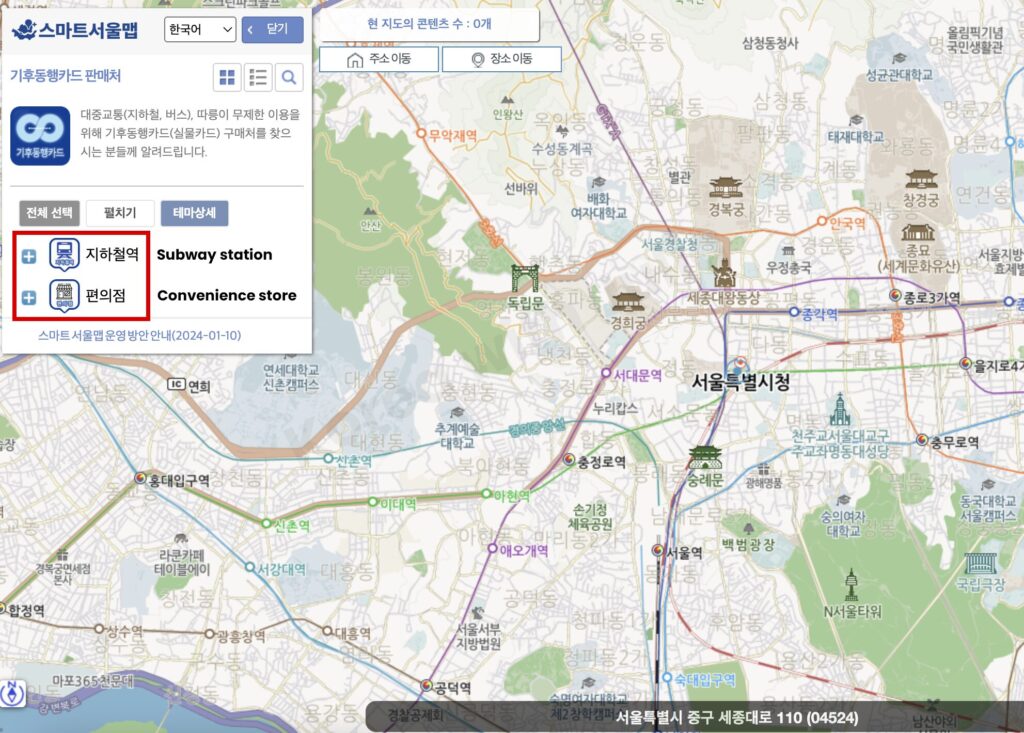
- You can search for subway stations only, convenience stores only, or both.
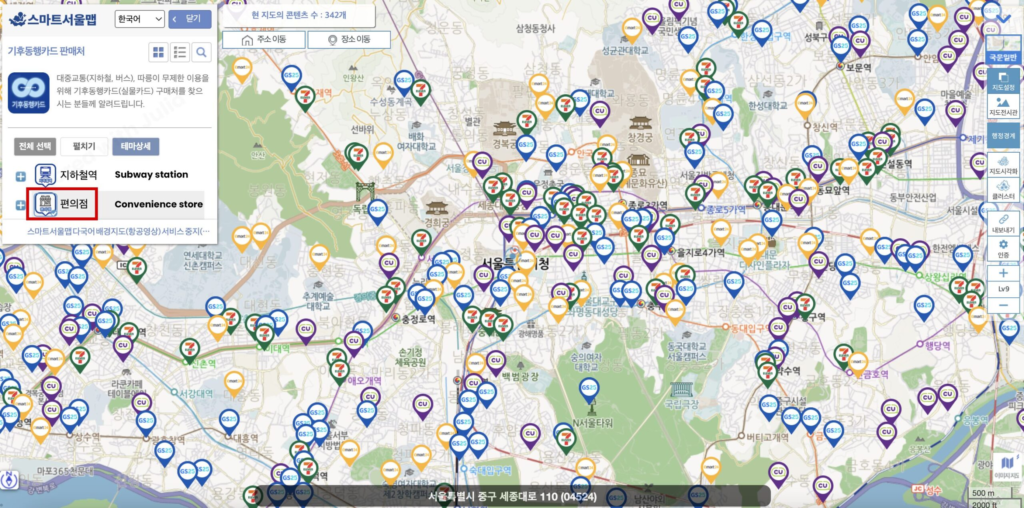
- The convenience store brands that sell the Climate Card are: 7-Eleven, CU, GS25, and Emart24.
Purchase & Top-Up
The physical Climate Card costs ₩3,000 per card.
You can pay with cash, credit card, or debit card.
After purchase, you should register your card on the T-money Card & Pay website or via the Mobile T-money app.
Only one card can be registered per person, and registration is required for refunds and for using Ttareungi (public bike).
You can scan the QR code on the back of the card to access the registration page.
However, registration requires a Korean phone number.
If you don’t have one and don’t need refunds, youth discounts, or bike access, registration is optional.
Unlike regular T-money cards, the Climate Card cannot be topped up at convenience stores.
There are two ways to top it up: top-up machines at subway stations and the mobile T-money app.
Subway Station Top-Up Machines
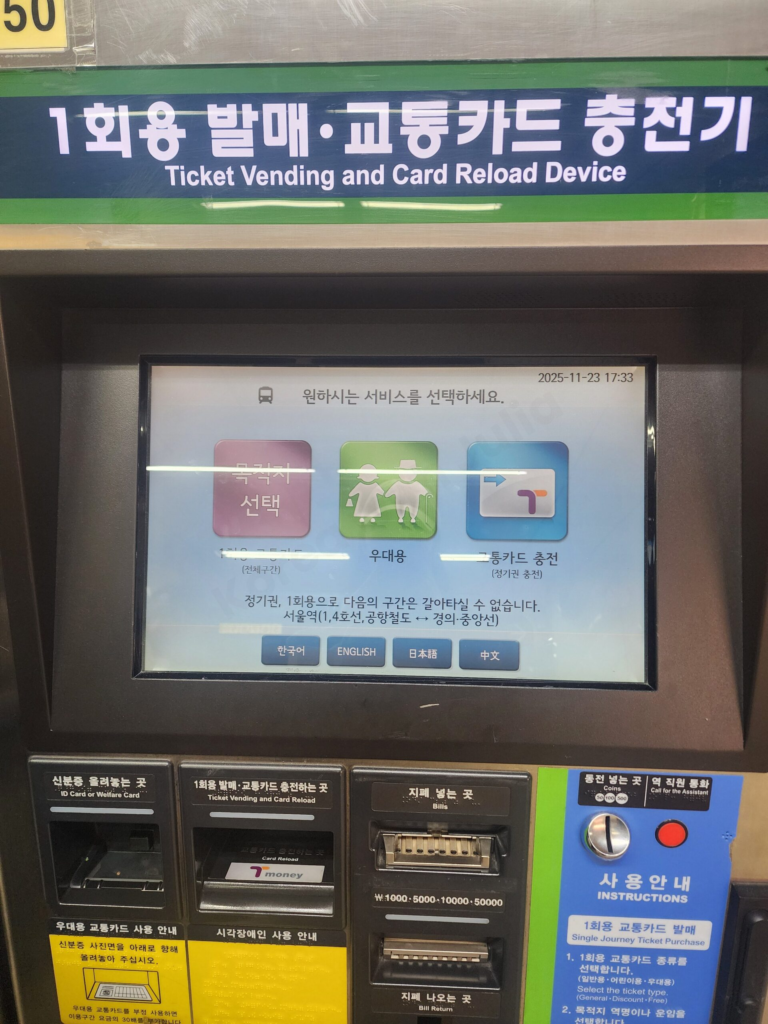
These machines are available in most subway stations.
However, Climate Card top-ups are only supported at stations on:
- Lines 1–9
- Ui-Sinseol Line
- Sillim Line
- Gimpo Gold Line
Unlike regular prepaid T-money cards, the Climate Card can be topped up with both cash and credit/debit cards.
Mobile T-money App
If paying at a subway station feels inconvenient, I’d recommend using the app.
Open the Physical Climate Card top-up menu, scan your card using NFC, select the period, and pay.
You can easily pay with a credit or debit card.
For 30-day passes, you can recharge from 5 days before the expiration date.
Short-term passes cannot be recharged in advance.
If you want to check official Seoul City information about the Climate Card,
visit: The Seoul Metropolitan Government’s English website
(Of course, this isn’t an affiliate link—though I wish it were haha)
It’d be nice to see Korea continue improving its public transportation card system.
As always, I’ll be back soon with another post to help make your life in Korea a little easier! 🇰🇷✨
Leave a Reply