
In Korea, January and February tend to be especially busy for both companies and employees.
If you’re working in Korea, you may have noticed that the word “tax” suddenly comes up a lot during this time of year.
This is because Korea has a system called Year-End Tax Adjustment.
Simply put, year-end tax adjustment is a process that recalculates the taxes that were automatically withheld from your salary throughout the year and compares them with your actual income and any expenses that qualify for tax deductions.
Based on this final calculation, you may receive a tax refund or be asked to pay a little more.
Even many Koreans find this system confusing. So if you’re a foreigner working in Korea, it’s completely normal to feel unfamiliar or overwhelmed.
Rather than diving into complex tax formulas, this article focuses on what year-end tax adjustment actually is, what foreign workers need to do, and what tax benefits may apply to you.
If this is your first year dealing with year-end tax adjustment in Korea, or if you’ve gone through it every year without really understanding it, this guide should help clarify the big picture.
What Is Year-End Tax Adjustment?
Year-end tax adjustment is the process of recalculating the income tax you paid in advance over the year based on your actual annual income.
In Korea, employers withhold income tax from employees’ salaries each month and pay it directly to the National Tax Service (NTS).
In theory, individuals could pay income tax themselves every month.
However, in reality, it would be nearly impossible for the tax authority to handle individual tax payments for every wage earner in the country.
So instead, companies withhold taxes from salaries, distribute the after-tax pay to employees, and then submit those taxes to the NTS on their behalf.
You can think of your employer as acting as a tax agent for the NTS.
The amount withheld each month is calculated using a simplified tax table for employment income.
For example, an employee earning ₩3 million per month might have tax withheld at X%, while someone earning ₩5 million per month might be taxed at Y%.
This calculation does not take into account personal factors, such as family dependents or actual spending. It’s only an estimate based on salary level.
As a result, the tax withheld throughout the year may differ from the tax you actually owe once your personal situation is fully considered.
Recalculating this accurately is exactly what year-end tax adjustment does.
The term “adjustment” reflects the process of comparing the taxes withheld each month with the final annual tax and settling the difference as either a refund or an additional payment.
There’s nothing extra you need to do personally about this adjustment.
Any additional payment or refund is usually reflected in your February or March paycheck.
For example, if your monthly salary is ₩4 million and the final calculation shows that you owe an additional ₩200,000, your February or March paycheck will be ₩3.8 million.
If you’re due a ₩200,000 refund, you’ll receive ₩4.2 million instead.
Do Foreign Workers Also Have to File Year-End Tax Adjustment?
If you are working for a company in Korea and receiving a salary, you are generally subject to year-end tax adjustment regardless of nationality.
According to the NTS, approximately 700,000 foreign workers were required to file year-end tax adjustment in February 2026.
For foreign workers, tax obligations differ depending on whether you are classified as a resident or non-resident for tax purposes.
You are considered a resident if you meet any of the following conditions:
- You have a home and registered address in Korea
- You have stayed in Korea for 183 days or more
- Your job requires you to stay in Korea for 183 days or more
- You have family in Korea and are expected to stay in the country for at least 183 days
If none of these apply, you are classified as a non-resident.
Foreign residents are required to pay tax on all income, both from inside and outside Korea (though tax treatment may vary depending on income type).
They are also eligible for the same deductions and tax credits as Korean residents.
Non-residents, on the other hand, are taxed only on income earned in Korea.
For detailed guidance, you can refer to the National Tax Service’s 2025 Year-End Tax Adjustment Manual for Foreign Workers.
📌 Visit the National Tax Service (NTS) English Website
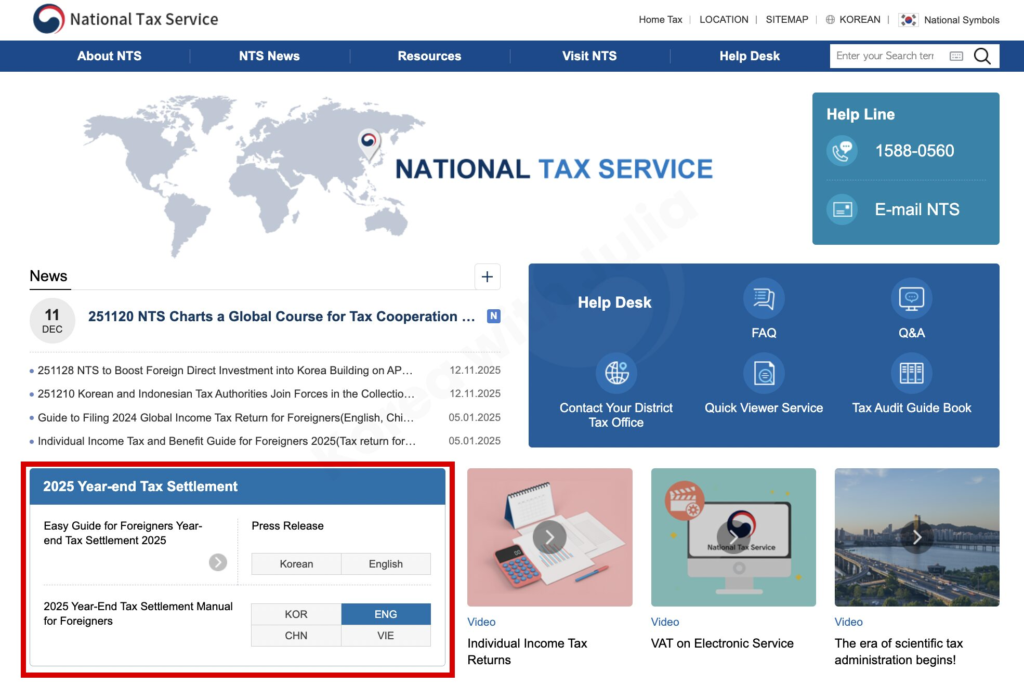
(FYI – Year-end tax adjustment conducted in 2026 applies to income earned in 2025, which is why the manual is labeled 2025.)
Documents Required for Year-End Tax Adjustment
The schedule and procedure for year-end tax adjustment are the same for foreign and Korean employees.
To complete the process, employees must submit documents related to:
- Family dependents
- Insurance premiums
- Medical expenses
- Education expenses
- Donations
- A portion of credit card spending
Most of this information can be found through the NTS’s simplified year-end tax settlement service.
Although these expenses come from your income, Korea treats some of them as deductible expenses.
In simple terms, they are considered money spent on basic living needs or socially important purposes. (This is not a technical tax term, but a helpful way to understand the concept.)
Because of this, these amounts are not fully counted as taxable income, and the tax base is adjusted accordingly.
For example, if you earn ₩5 million per month and spend ₩1 million on deductible expenses such as insurance or medical bills, the government calculates your tax based on a lower taxable income.
However, since your employer already withheld tax based on the full ₩5 million salary, the final recalculation during year-end adjustment creates a difference—resulting in either a refund or additional payment.
When submitting documents, it’s important to check whether your company uses the One-Stop Document Service.
Companies using this service can access employees’ simplified year-end tax settlement data with their consent.
If your company does not use the One-Stop Document Service, you’ll need to download your simplified year-end tax settlement data yourself and submit it to your employer.
If you have deductible items not included in the simplified year-end tax settlement data, you must submit those separately.
These may include:
- Medical receipts not shown in the simplified data
- Education or medical expenses paid overseas
- Donations not automatically reflected
- Documents related to dependents or family members living abroad
Comprehensive Income Tax Filing (in May)
If you work as a freelancer or are self-employed rather than being a salaried employee, or if you are salaried but have additional income, you must file your income taxes on your own.
Unlike year-end tax adjustment, comprehensive income tax filing is done every May.
You may need to file directly if any of the following apply to you:
- You work as a freelancer
- You have business income
- You earned salary from multiple employers and year-end adjustment was not properly consolidated
- Your employer did not process year-end adjustment
- You have employment income without withholding
- You resigned during the year
- You earned part-time income (excluding daily labor contracts)
- You earned over ₩3 million in other income
More detailed explanations will be covered in a separate post.
Tax Benefits for Foreign Workers (2026)
In addition to general deductions, there are tax benefits that apply only to foreign workers in Korea.
According to the NTS, there are four major tax benefits available to foreign workers in 2026.
Housing-Purchase Savings Deduction
Under Korea’s Resident Registration Act, foreign residents cannot be registered as a head of household (for tax purposes).
Because of this, foreign residents who did not own a home were not eligible for the housing-purchase savings deduction in the past, even if they were saving to buy one.
Housing-purchase savings refers to a system in which you deposit money into a designated savings account for buying a home, and a certain percentage of those savings is deducted from your taxable income.
(As mentioned earlier, these savings are also considered money spent on basic living needs or socially important purposes.)
The eligibility has now expanded to include spouses of heads of household.
If foreign workers meet all of the following conditions:
- residing in Korea
- earning ₩70 million or less annually
- being the spouse of a head of household who does not own a home
they may qualify to deduct 40% of their housing-purchase savings, up to ₩3 million per year.
(Only for savings made during 2025.)
Tax Reduction for Foreign Engineers
Foreign workers may qualify for a 50% reduction in income tax for up to 10 years if they:
- provide technical services in Korea under an engineering technology licensing agreement
- or hold a bachelor’s degree or higher in science or engineering and have overseas R&D experience
In short, this benefit is designed for highly skilled foreign professionals working in technical fields in Korea.
If such a worker is employed by a government-recognized company in key industries—such as defense, electric vehicles, or semiconductors—the tax reduction increases to 70% for the first three years.
Flat Tax Rate of 19%
Foreign workers may choose to apply either:
- A flat tax rate of 19%, or
- Korea’s progressive income tax rates
This option is available for up to 20 years, starting from the year you first begin working in Korea.
However, foreign workers who own 30% or more of the company or who are otherwise in a special relationship with the company are excluded.
Income Tax Exemption for Native Language Teachers
If Korea has a tax treaty with the teacher’s home country that includes a tax exemption for teachers and/or professors, foreign teachers who meet the eligibility requirements may be exempt from income tax on income earned from teaching and research.
Specific conditions vary by country, so teachers should check the applicable tax treaty through the NTS’s Tax Law Information System.
📌 Check the NTS Tax Law Information System
Tax treaties are available in Korean and English, but the website interface itself is Korean-only. Using a browser’s translation feature is recommended.
Where to Find More Information
The National Tax Service provides a year-end tax adjustment guide and related manuals on its official website.
The guide is available in English, and the manuals are offered in English, Chinese, and Vietnamese.
📌 Visit the National Tax Service (NTS) English Website
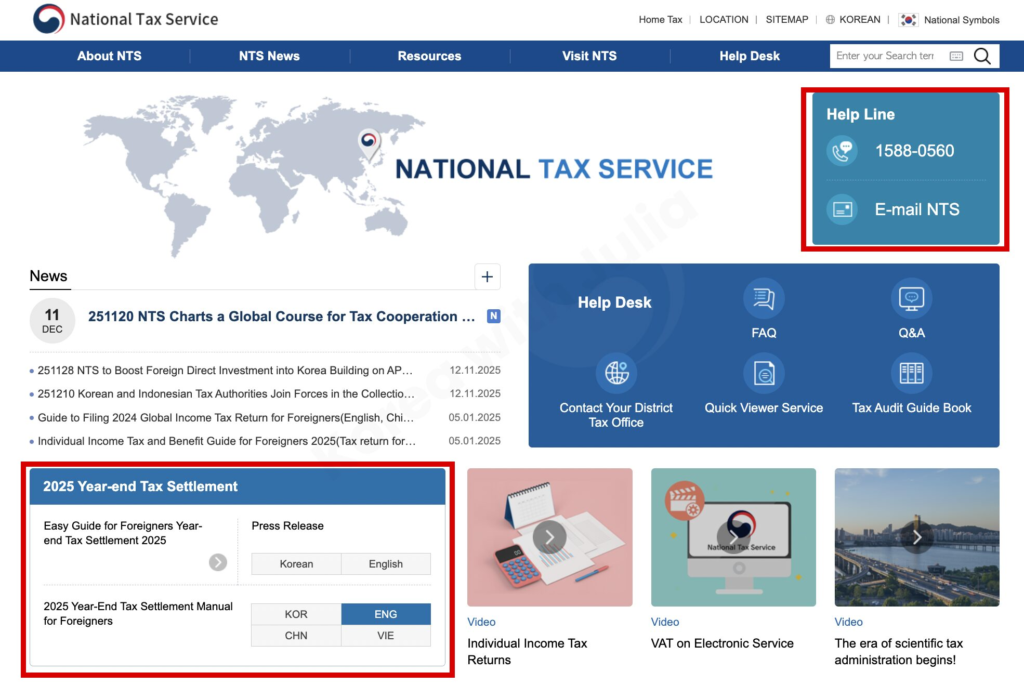
Foreign workers can also use the English consultation hotline (1588-0560) for personalized assistance with year-end tax adjustment.
And of course—if there’s a topic you’d like to see covered on Korea with Julia, feel free to leave a comment or send me an email anytime! 🇰🇷✨
Leave a Reply