
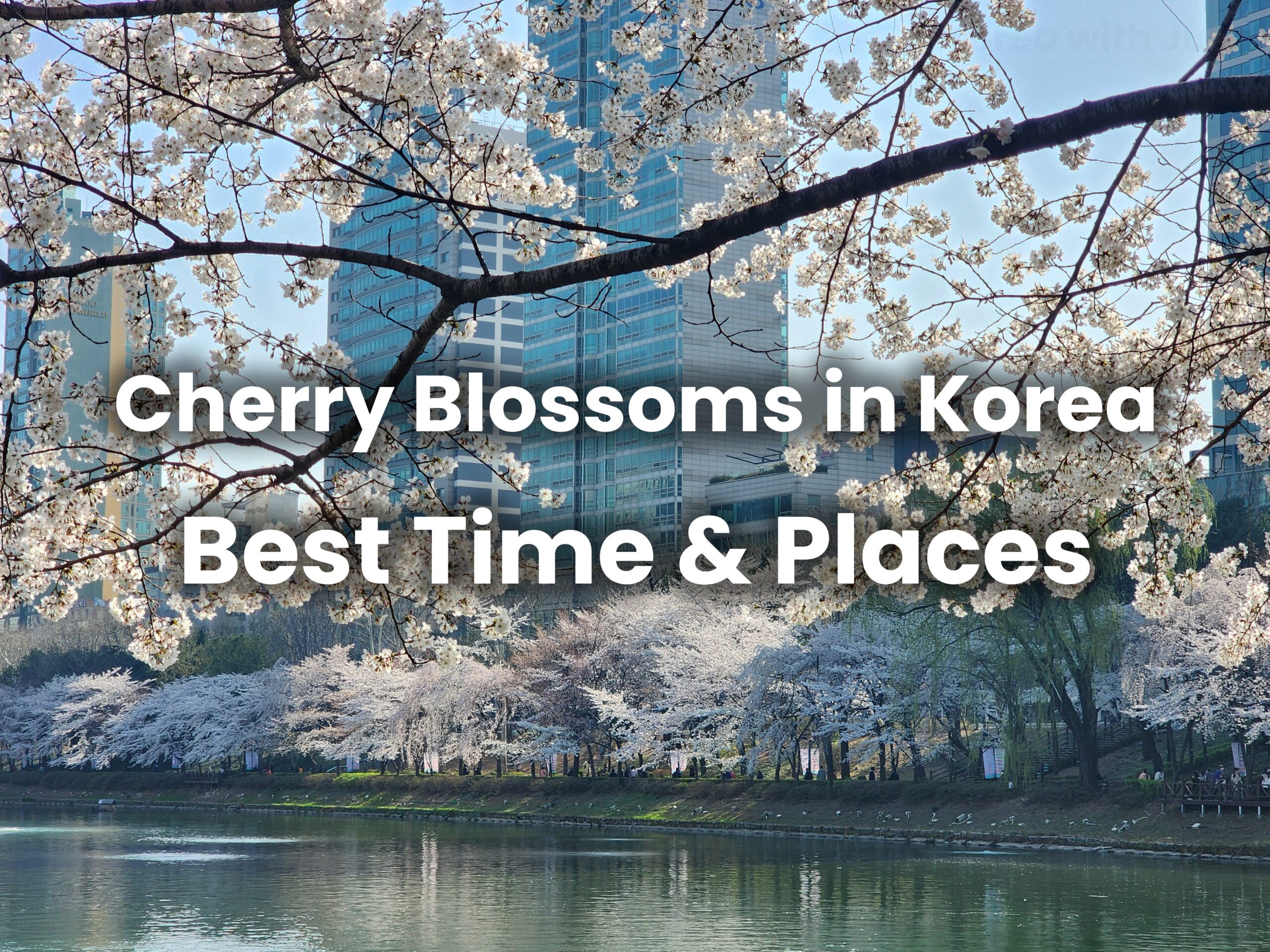
As the weather gets warmer, I hope you’re starting to feel that little excitement of spring in Korea.
Spring in Korea just isn’t complete without flower viewing.
You probably guessed it—this post is all about cherry blossoms.
From late March to early-to-mid April, cherry blossom festivals take place all across the country.
Honestly, it’s one of the busiest times of the year in Korea—sometimes even more crowded than Christmas markets!
So in this guide, let’s take a closer look at how cherry blossom festivals started in Korea, when they bloom in 2026, and where you can actually go to see them.
The History of Cherry Blossoms in Korea
Most people think of cherry blossoms as a Japanese flower (sakura), but cherry trees have also actually existed in Korea as well.
On Jeju Island, there are naturally growing native King Cherry trees, and genetic studies show that they are a different species from Japanese cherry trees.
That said, most of the cherry blossoms you see on the streets in Korea today are “Somei Yoshino,” a cultivated variety developed in Japan.
The reason cherry trees became so widespread in Korea is tied to the Japanese colonial period (1910–1945).
During that time, Japan planted cherry trees throughout Korea—in palaces, parks, and along streets—as part of urban beautification and colonial policies.
They turned Changgyeonggung Palace, originally a royal palace, into a zoo and a cherry blossom park. They also transformed Jinhae into a naval port city and planted large numbers of cherry trees there.
That’s why many of today’s famous cherry blossom streets in Korea have their origins in that period.
Today, however, there are growing efforts to replace these trees with native species.
In Yeouido, Seoul—home to the National Assembly—a project has been underway since 2024 to replace aging or pest-damaged cherry trees with native Korean Jeju King cherry trees instead of Japanese varieties.
Cherry blossom festivals have a similar background. They were not originally part of traditional Korean culture.
During the Joseon Dynasty, people enjoyed flowers like plum blossoms, azaleas, and peach blossoms instead.
Cherry blossom viewing became popular during the colonial era, influenced by Japan’s hanami (cherry blossom viewing) culture.
In the 1920s, the Japanese Government-General even held nighttime cherry blossom viewing events at Changgyeonggung Palace to ease public sentiment—and this gradually spread into popular culture.
After independence, there were attempts to remove cherry trees as remnants of colonial rule.
However, since they were already widespread and visually beautiful, many were left in place.
Eventually, from the 1960s–70s onward, cherry blossom viewing was reborn as local spring festivals.
Cherry Blossom Forecast in Korea (2026)
In 2026, cherry blossoms are expected to bloom about 2–3 days earlier than usual, with peak season falling between late March and early April.
Exact timing can vary slightly depending on the weather and region.
Here are the estimated bloom dates for major cities:
| City | Expected Bloom Date |
|---|---|
| Jeju | March 25 |
| Busan | March 25 |
| Ulsan | March 26 |
| Daegu | March 26 |
| Pohang | March 26 |
| Changwon | March 27 |
| Gwangju | March 27 |
| Mokpo | March 28 |
| Jeonju | March 28 |
| Yeosu | March 29 |
| Daejeon | March 31 |
| Gangneung | April 1 |
| Andong | April 2 |
| Seoul | April 3 |
| Seosan | April 4 |
| Suwon | April 5 |
| Incheon | April 7 |
| Chuncheon | April 8 |
Best Cherry Blossom Festivals in Korea (2026)
Jinhae Gunhangje Festival (진해 군항제)
This is the largest cherry blossom festival in Korea, with around 360,000 cherry trees spread across the entire city of Jinhae.
It’s not just one park—the whole city basically turns into a festival.
The most famous spots are the 1.5 km Yeojwacheon cherry blossom tunnel and the Gyeonghwa Station railway.
At night, the combination of lights and blossoms creates a completely different atmosphere.
Originally, the Gunhangje festival started as a memorial event for Admiral Yi Sun-sin.
During the festival, even the Naval Academy, which is usually closed to the public, opens its doors.
You can also watch military band parades and honor guard ceremonies.
📍 Location
- Jinhae-gu, Changwon, Gyeongsangnam-do
📅 Dates
- March 27 – April 5, 2026
Yeouido Spring Flower Festival (여의도 봄꽃축제)
This is Seoul’s most iconic cherry blossom festival, with over 1,700 cherry trees.
You can walk along the 1.7 km Yunjung-ro cherry blossom road behind the National Assembly.
Rather than being performance-heavy, this festival is more about simply walking and enjoying the blossoms together.
During the festival, the area becomes a car-free street, so people can walk freely not only on sidewalks but also on the road.
📍 Location
- Yunjung-ro, Yeouido, Yeongdeungpo-gu, Seoul
📅 Dates
- April 3 – April 7, 2026
Seokchon Lake Cherry Blossom Festival (석촌호수 벚꽃축제)
Although it has a shorter history than the Yeouido Festival, Seokchon Lake is now considered one of the top cherry blossom spots in Seoul.
Around 1,000 cherry trees surround the 2.5 km walking path, creating a beautiful tunnel-like effect.
You’ll also get a unique view of cherry blossoms alongside the lake and Lotte World Tower, a striking super-tall skyscraper.
At night, the reflections of lights and blossoms on the lake are especially stunning.
If you love taking photos, I’d definitely recommend this spot.
📍 Location
- Seokchon Lake, Jamsil, Songpa-gu, Seoul
📅 Dates
- April 3 – April 11, 2026
Gyeongju Daereungwon Cherry Blossom Festival (경주 대릉원 벚꽃축제)
If you want to enjoy cherry blossoms with a historical backdrop, Gyeongju is the city to go.
You can walk along the stone wall path of Daereungwon, where cherry blossoms bloom against the backdrop of ancient Silla royal tombs.
You can also visit famous sites like Cheomseongdae Observatory and Bulguksa Temple while enjoying the cherry blossoms.
At Bomun Lake, you can walk along a 2 km path surrounded by cherry blossoms.
During the festival, the area around the stone wall path also comes alive with busking performances and nighttime light shows.
📍 Location
- Daereungwon area, Gyeongju, Gyeongsangbuk-do
📅 Dates
- April 3 – April 5, 2026
Jeju Jeonnong-ro King Cherry Blossom Festival (제주 전농로 왕벚꽃축제)
What makes Jeju special is that you can see King Cherry blossoms, not just regular ones.
These flowers are larger, fuller, and more vibrant than typical cherry blossoms.
Along Jeonnong-ro, cherry trees line a 3 km stretch of the street so densely that it feels like walking through a tunnel of cherry blossoms.
If you’re looking for a more unique cherry blossom experience in Korea, Jeju is definitely worth visiting.
📍 Location
- Jeonnong-ro, Jeju-si, Jeju-do
📅 Dates
- March 27 – March 29, 2026
Other Cherry Blossom Festivals in Korea
In reality, almost every city in Korea hosts its own cherry blossom festival, big or small.
That means you don’t have to be in a major city or the capital area to enjoy them—there’s likely a beautiful spot near you.
Here are some other well-known festivals and scenic drives you might want to check out if you’re nearby:
- Hadong Hwagae Market Cherry Blossom Festival (하동 화개장터 벚꽃축제): March 27 – March 29, 2026
- Gurye 300-ri Cherry Blossom Festival (구례 300리 벚꽃축제): March 28 – March 30, 2026
- Gunsan Eunpa Cherry Blossom Night Market (군산 은파 벚꽃야시장): March 28 – April 12, 2026
- Gongju Gongsanseong Fortress Cherry Blossom Spot (공주 공산성 벚꽃 명소)
- Gangneung Gyeongpo Cherry Blossom Festival (강릉 경포벚꽃축제): April 4 – April 11, 2026
- Yangpyeong Namhan River Cherry Blossom Drive (양평 남한강 벚꽃 드라이브 코스)
- Chuncheon Soyang River Cherry Blossom Spots (춘천 소양강 벚꽃 명소)
In fact, beyond these famous places, cherry blossoms are everywhere in Korea.
You might find them in an apartment complex, along a river, or even in a small neighborhood park.
Sometimes, the best photos come from those unexpected spots you discover while just walking around.
Cherry blossoms are beautiful no matter where you see them.
But personally, I prefer enjoying cherry blossoms in quiet, less crowded places.
If this is your first spring in Korea, I’d recommend visiting one of the major festivals.
But if you’ve been here for a long time, maybe it’s time to find your own hidden cherry blossom spot!
I truly hope your spring in Korea is filled with beautiful flowers! 🌸🇰🇷
Leave a Reply