
Korean food uses a wide variety of ingredients—especially when it comes to broths, sauces, and seasonings.
Because of this, checking ingredients carefully is essential if you have a food allergy.
At restaurants, you can usually ask the staff or check the menu.
But when you’re buying food at supermarkets or convenience stores, that’s not always easy.
The good news is that Korea has a mandatory allergen labeling system for packaged and imported foods manufactured in factories.
This system is required under the Food Labeling and Advertising Act, as well as official notifications issued by the Ministry of Food and Drug Safety.
In other words, most packaged foods you encounter in Korea will include allergy information.
In this guide, I’ll walk you through:
- how allergy information is labeled in Korea,
- which food groups are declared as allergens,
- and how Korean allergy statements are translated into English.
Let’s get started!
How Allergy Information Is Labeled in Korea
All factory-produced packaged foods in Korea list basic food information such as ingredients and calories.
(just like food products in many other countries!)
Allergy-related information is usually included in the same section.
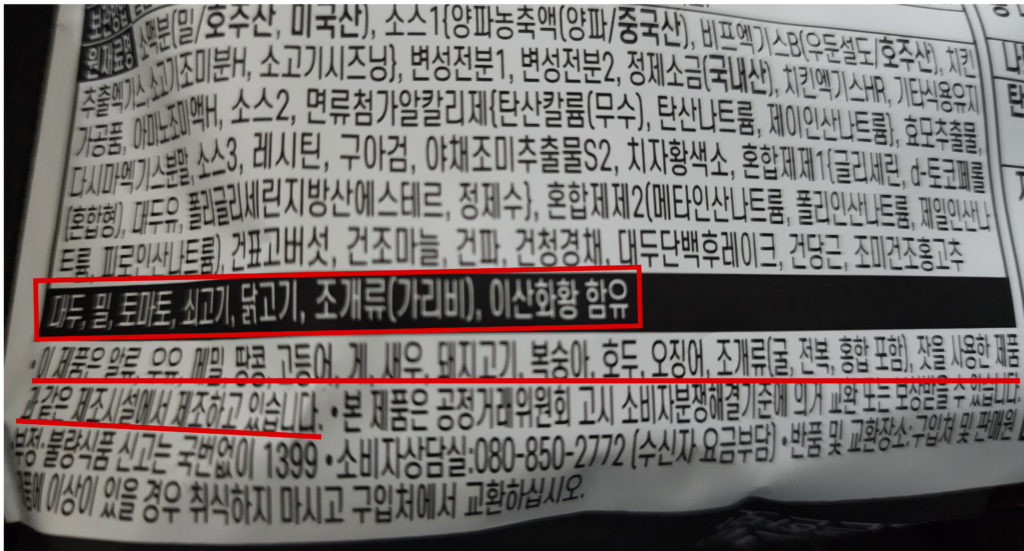
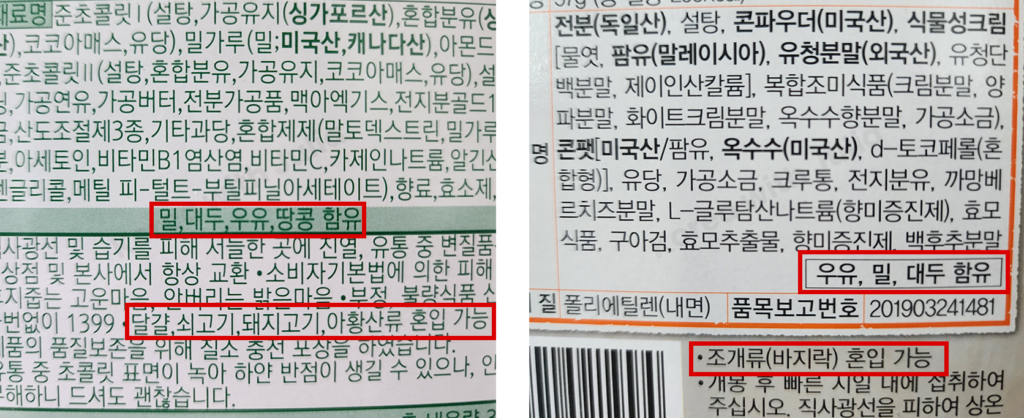
There are four common types of allergy statements you’ll see on Korean food labels.
Since all of this information is written in Korean, it can be confusing if you’re not familiar with the language.
I’ll show you the original Korean phrases alongside their English translations, so try to remember these key phrases—they’ll come in handy when shopping!
1. “함유” → Contains
When you see 함유, it means the allergen is directly used as an ingredient.
This is the clearest and strongest form of allergen labeling.
Examples:
- 알레르기 유발물질: 우유, 대두 함유
→ Allergens: Contains milk and soy. - 이 제품은 밀, 계란을 함유하고 있습니다.
→ This product contains wheat and eggs.
The ingredients listed before “함유” are the allergens you should pay attention to.
(I’ll go over the key allergenic ingredients and their English translations in more detail below!)
2. “포함” → Contains
포함 has the same meaning as 함유, and it is also translated as contains in English.
However, 포함 appears in a wider variety of formats—most commonly in parentheses within the ingredient list.
For example:
원재료명: 밀가루(밀), 설탕, 우유, 대두유
This means wheat (밀) is included in the flour.
If you have a wheat allergy, this is a product you should avoid.
Because parenthetical labeling is very common, it’s important to check ingredient lists carefully.
Examples:
- 원재료명: 밀가루(밀), 설탕, 우유, 대두유
→ Ingredients: Wheat flour (wheat), sugar, milk, soybean oil. - 알레르기 유발물질: 우유, 대두 포함
→ Allergens: Contains milk and soy. - 본 제품에는 우유 성분이 포함되어 있습니다.
→ This product contains milk. - 이 제품은 땅콩을 포함한 원료로 제조되었습니다.
→ This product is made with ingredients that contain peanuts.
3. “혼입 가능” / “같은 제조시설” → May contain / Processed in the same facility
These phrases mean that the allergen is not intentionally used as an ingredient, but may be present due to cross-contamination during manufacturing.
Who knows, there could be tiny traces of peanut shells or peach fuzz left on shared equipment?
For people with severe allergies, even very small amounts can cause reactions, which is why these warnings are commonly used for consumer safety.
Examples:
- 이 제품은 계란, 우유, 땅콩을 사용한 제품과 같은 제조시설에서 제조하고 있습니다.
→ Produced in a facility that also processes eggs, milk, and peanuts. - 알레르기 유발물질이 혼입될 수 있습니다.
→ May contain allergens.
4. “미량 포함 가능” → May contain
Like the previous category, this phrase warns that trace amounts of an allergen may be present.
Example:
- 우유 성분이 미량 포함될 수 있습니다.
→ May contain milk.
21 Food Groups That Must Be Listed as Allergens in Korea
Now that you know how allergens are labeled, let’s look at which allergens are legally required to be declared in Korea.
As of 2025, 21 food items must be listed as allergens on Korean food labels.
Since these are written in Korean, the English translations below may help you spot them more easily.
| Category | Korean | English |
|---|---|---|
| Eggs | 계란 | Eggs |
| Dairy | 우유 | Milk |
| Grains | 밀 | Wheat |
| Grains | 메밀 | Buckwheat |
| Legumes | 대두 | Soy / Soybeans |
| Nuts | 땅콩 | Peanuts |
| Nuts | 호두 | Walnuts |
| Nuts | 잣 | Pine nuts |
| Meat | 돼지고기 | Pork |
| Meat | 소고기 | Beef |
| Meat | 닭고기 | Chicken |
| Fish | 고등어 | Mackerel |
| Crustaceans | 게 | Crab |
| Crustaceans | 새우 | Shrimp |
| Mollusks | 오징어 | Squid |
| Shellfish | 조개류(굴·전복·홍합) | Shellfish (including oyster, abalone, mussel) |
| Fruit | 복숭아 | Peach |
| Fruit | 토마토 | Tomato |
| Additives | 아황산류 | Sulfites |
Finding Allergens in the Ingredient List
Allergens that are not part of Korea’s mandatory list of 21 must be checked manually in the ingredient list (원재료명) by the consumer.
This is especially important because many countries consider additional foods—such as more types of fish, nuts, and shellfish—as major allergens.
Below are common allergenic foods you may want to watch for. If you have allergies, always double-check whether these keywords appear on the label.
Tree Nuts
| Korean | English |
|---|---|
| 아몬드 | Almonds |
| 캐슈넛 | Cashews |
| 피칸 | Pecans |
| 헤이즐넛 | Hazelnuts |
| 마카다미아 | Macadamia nuts |
| 브라질너트 | Brazil nuts |
| 피스타치오 | Pistachios |
Sesame
| Korean | English |
|---|---|
| 참깨 | Sesame |
Fish
| Korean | English |
|---|---|
| 연어 | Salmon |
| 참치 | Tuna |
| 대구 | Cod |
| 정어리 | Sardine |
| 넙치 | Halibut |
Crustaceans
| Korean | English |
|---|---|
| 랍스터 | Lobster |
| 가재 | Crayfish |
| 크릴 | Krill |
Mollusks (Molluscs)
| Korean | English |
|---|---|
| 문어 | Octopus |
| 달팽이 | Snails |
| 홍합 | Mussels |
| 바지락 | Clams |
Mustard
| Korean | English |
|---|---|
| 겨자 | Mustard |
Celery
| Korean | English |
|---|---|
| 셀러리 | Celery |
Mushrooms
Mushrooms can appear in many forms—not only as fresh ingredients, but also as dried mushrooms, powders, extracts, concentrates, or blended ingredients.
Because of this, it’s a good idea to remember the word “버섯(mushroom)” itself and check ingredient lists carefully if you’re sensitive or allergic.
| Korean | English |
|---|---|
| 버섯 | Mushroom |
Lupin
| Korean | English |
|---|---|
| 루핀 / 루핀콩 | Lupin |
Corn
| Korean | English |
|---|---|
| 옥수수 | Corn / Maize |
Gluten-Containing Grains
| Korean | English |
|---|---|
| 보리 | Barley |
| 호밀 | Rye |
| 귀리 | Oats |
For a Safer and Healthier Food Experience in Korea
Living in or traveling to Korea with food allergies can feel overwhelming—but once you know where to look and which keywords to remember, reading Korean food labels can be much easier.
If you’d like more help understanding Korean food labels, need Korean-to-English allergy translations, or find ingredient lists confusing, feel free to reach out at [email protected] anytime.
I’m always happy to help you shop, eat, and enjoy Korean food more safely and confidently!🇰🇷✨
Leave a Reply