
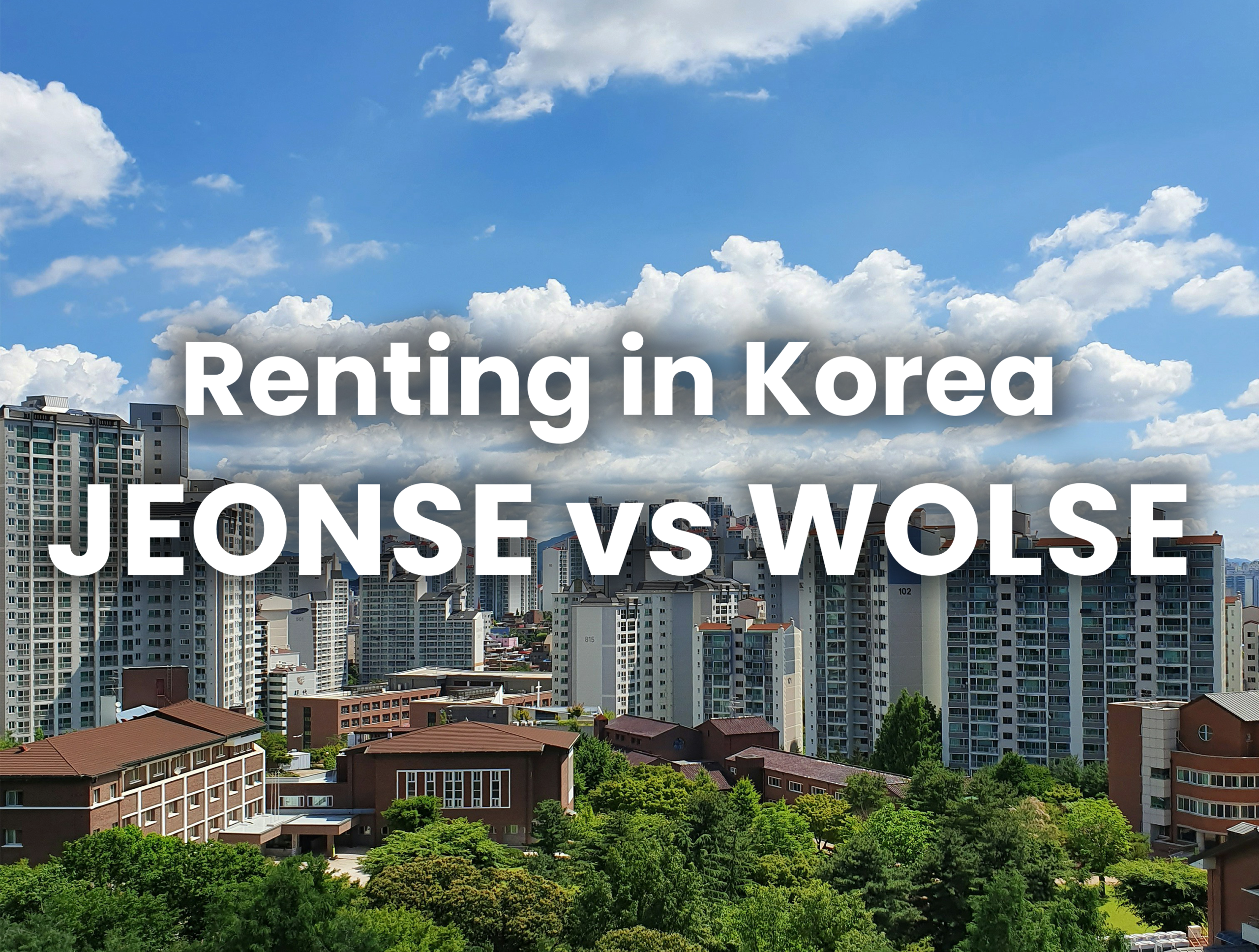
Finding a place to live in Korea as a foreigner is never easy.
(Honestly… even as a Korean, I still find house hunting in Korea stressful.)
Before you jump into apartment hunting in Korea, there’s something you should understand first. Korea’s rental system works differently from most other countries.
In many parts of the world, the standard rental system is simple — you pay a security deposit of one or two months’ rent, and then you pay rent each month.
But in Korea, deposits can be dramatically higher. There is even a system where you don’t pay monthly rent at all, but instead leave a massive lump-sum deposit with the landlord.
That was a long introduction. So now, let’s get into the real details.
How Renting Works in Korea
Korea’s rental market is built around three main types of contracts: Jeonse (Lump-sum deposit lease, 전세), Wolse (Monthly rent, 월세), Ban-jeonse (Hybrid deposit & rent system, 반전세)
All three use a deposit, but the size of that deposit and the financial burden on the tenant vary greatly depending on which system you choose.
Depending on the contract, you might pay no monthly rent at all and put down a huge lump-sum deposit, pay a small deposit with full monthly rent, or pay a large deposit plus a smaller monthly rent.
That’s why, when you look for housing in Korea, you shouldn’t judge a place by monthly rent alone. What really matters is which rental structure fits your financial situation best.
In Korea, deposits are often much higher than what you might be used to back home.
In many cases, even relatively affordable monthly rent can require a deposit equal to one or two years’ worth of rent.
What is “Jeonse”?
Jeonse is a unique Korean rental system where the tenant deposits a huge lump sum, which is usually around 50% or more of the property’s value, and pays no monthly rent during the contract period. This system is extremely rare outside Korea.
For example, if an apartment is worth ₩600,000,000, a typical Jeonse deposit might range from ₩300,000,000 to ₩480,000,000.
That range is a market convention, not a legal rule. There is no legal cap on Jeonse deposits.
The exact amount is decided by the landlord and market demand.
Even if a landlord wants to set a very high deposit, they still need to match the market. Otherwise, they simply won’t find a tenant.
Contract Period and Renewal
A standard Jeonse contract lasts two years. When the contract is about to end, one of three things happens:
- The tenant exercises their legal right to request contract renewal
- The tenant and landlord sign a brand-new contract
- The tenant moves out and the contract ends
Under Korea’s Housing Lease Protection Act, tenants can request a two-year extension between six and two months before the contract expires.
This means a standard two-year Jeonse contract can legally become four years in total.
During this renewal, the landlord cannot refuse the request without just cause.
Just Causes a Landlord May Refuse Renewal:
- The landlord or their immediate family member (such as a parent or child) plans to move in
- The tenant provided false information
- The contract was signed through fraud or misrepresentation
- The tenant caused serious property damage
- The tenant subleased without permission
These are some of the most common and representative reasons.
Other legally recognized grounds for refusal may also apply depending on the situation.
Automatic Renewal (Tacit Renewal)
If neither side gives formal notice before the contract expires, the lease is often automatically renewed under the same terms.
In this case, the deposit and all conditions usually remain unchanged.
The tenant may give notice to terminate at any time during a tacit renewal.
However, the termination only becomes effective three months after the landlord receives the notice.
Sometimes, landlords agree to extend the stay but ask for a small deposit increase.
When the tenant is exercising the legal right to request contract renewal, the deposit increase is generally capped at 5%.
For example, if you initially paid a Jeonse deposit of a ₩200,000,000, the landlord can only raise it by up to 5% at renewal, which comes out to a maximum increase of a ₩10,000,000.
Important Warning: “New Contract” vs “Legal Renewal”
You must be careful when the landlord suggests signing a brand-new contract.
If you sign a new contract instead of renewing under your legal right, there is no legal limit on how much the deposit can increase.
This is when tenants, especially foreigners, often end up paying far more than expected.
Getting Your Jeonse Deposit Back
When a Jeonse lease ends and the tenant moves out, the deposit is returned in full in principle.
However, any unpaid maintenance fees or repair costs caused by the tenant may be deducted. Normal wear and tear is not deductible.
What Does the Landlord Do With the Jeonse Deposit?
The Jeonse deposit effectively functions like an interest-free loan for the landlord.
The landlord may use it to invest, pay off mortgage loans, earn interest through a bank, or purchase another property.
So while the tenant benefits from not having to pay monthly rent, the landlord benefits from having access to a large sum of money.
What is “Wolse”?
Wolse is the familiar monthly rent system in which tenants pay a smaller deposit along with monthly rent.
Most foreigners would already know this system, and it is the most common rental type for foreigners in Korea.
Wolse contracts are commonly written for 1–2 years.
Under Korean housing law, a lease shorter than two years is generally treated as a two-year contract unless the tenant agrees otherwise.
The deposit is typically 10–20 times the monthly rent.
For example, if the monthly rent is ₩500,000, the deposit is around ₩10,000,000.
However, monthly rent and deposit vary widely by location and market demand.
These ratios are often adjustable through negotiation — for example, a ₩10,000,000 deposit with ₩600,000 in monthly rent, or a ₩50,000,000 deposit with ₩300,000 in monthly rent.
Contract Period and Renewal
Wolse contracts follow the same legal renewal system as Jeonse.
In Wolse contracts as well, tenants can exercise their legal right to request a contract renewal between six and two months before the contract expires.
This means a one-year contract can be extended by another year, and a two-year contract by another two years.
Here as well, the landlord cannot refuse a renewal request without just cause. Those reasons are the same as those that apply to Jeonse contracts.
However, if rent is overdue for two months or more, the landlord may legally refuse renewal.
If renewal is based on the tenant’s legal right, rent and deposit increases are also generally capped at 5%. (The same rule applies to Jeonse!)
For example, if you originally paid a Wolse deposit of ₩10,000,000 and monthly rent of ₩1,000,000, both the deposit and the rent can only be increased by up to 5% at renewal. This means the deposit can rise to a maximum of ₩10,500,000, and the monthly rent to ₩1,050,000.
If a new contract is signed instead of a renewal, this legal limit no longer applies. In that case, both the rent and the deposit can be increased freely based on market rates.
Tenant Warning: Unpaid Rent = Deposit Deduction
In Wolse contracts, the deposit acts as a financial safety net.
If a tenant moves out without fully paying rent, any unpaid rent, unpaid maintenance fees, and repair costs caused by the tenant will be deducted from the deposit.
If rent is overdue for two months or more, you may even lose your legal right to request a contract renewal.
What is “Ban-Jeonse”?
Ban-Jeonse literally means “Half-Jeonse.”
You pay a large deposit (less than Jeonse)and a smaller monthly rent (less than Wolse).
For example, instead of paying a ₩200,000,000 Jeonse deposit, you might pay a ₩100,000,000 deposit with ₩500,000 monthly rent.
This allows landlords to earn monthly income and tenants to reduce their deposit burden.
It’s a good option if you have some savings but still want to lower monthly rent.
However, Ban-Jeonse listings are far less common than standard Wolse.
💡Summary: Pros and Cons of Each Rental Type
Every contract type has clear pros and cons. The key is choosing what matches your lifestyle, budget, and risk tolerance.
Jeonse – Pros and Cons
Pros
- No monthly rent
You don’t have to pay rent every month, which means no fixed monthly housing expense - Good for long-term stays
With two-year contracts and the legal right to renewal, you can stay up to four years. - No risk of rent increases
Since there is no rent, you don’t have to worry about rising monthly payments. - Deposit is returned in full in principle
Your housing cost is often seen as “money kept” rather than “money spent.”
Cons
- Extremely high upfront cost
You need a massive lump-sum deposit, often tens or hundreds of millions of won. - Your money is locked in
The deposit cannot be used during the lease period. - Risk of not getting your deposit back (Jeonse fraud risk)
If the landlord goes bankrupt or the home is auctioned, you may lose part or all of your deposit. - Not easy for foreigners
Large deposits, financial systems, and insurance requirements make Jeonse hard to access for many foreigners.
Wolse – Pros and Cons
Pros
- Much lower upfront cost than Jeonse
You can move in right away with a relatively small deposit. - Ideal for short-term stays
Perfect for students, working holiday makers, and short-term residents. - Lower risk of large-scale deposit loss
Compared to Jeonse, the financial damage from scams or disputes is much smaller. - Easy to move in and out
Since no large lump sum is locked in, moving or leaving Korea is financially easier.
Cons
- Ongoing fixed monthly expenses
Paying ₩500,000–₩1,000,000 in rent every month can become a heavy long-term burden. - More expensive in the long run
Over time, total housing costs can exceed those of Jeonse. - Rent may increase at renewal
Monthly payments can rise when the contract is renewed.
Ban-Jeonse – Pros and Cons
Pros
- Lower upfront deposit than Jeonse
- Lower monthly burden than Wolse
- Flexible negotiation between deposit and rent
- A realistic middle option for many tenants
Ideal for those who can’t afford a full Jeonse deposit but find full Wolse too expensive in the long run.
Cons
- You carry disadvantages of both Jeonse and Wolse
You still pay a large deposit and also have ongoing monthly rent. - More complex contract structure
The mixed system can be confusing, especially for foreigners. - Risk of being converted into full Wolse at renewal
At renewal, Ban-Jeonse may switch to Wolse, often with a higher monthly rent. - Fewer listings available
Since Ban-Jeonse is not ideal for many landlords financially, these units can be harder to find.
So, Which One is Better for Foreigners?
Realistically, Wolse is the safest and most practical choice for most foreigners.
It has a lower upfront cost, a simple structure, lower fraud risk, and far more rental listings available.
Wolse is best if you:
- Plan to stay less than 3 years
- Are a student, working holiday maker, or short-term employee
- Are still learning Korea’s housing system
Ban-Jeonse can be a solid second option if you:
- Have enough savings to cover the deposit
- Understand the contract structure
Jeonse should be approached with the most caution by foreigners.
It may look attractive because you don’t pay monthly rent and usually get your full deposit back at the end.
However, Jeonse requires an extremely large upfront payment and carries real deposit-return risks depending on the landlord’s financial situation. (It’s honestly difficult even for many Koreans.)
Jeonse may be considered only if you:
- Plan to stay in Korea long-term
- Have substantial savings for a large lump-sum deposit
- Fully understand Korea’s housing system, legal procedures, and deposit protection tools
One Step Closer to Your Home Sweet Home
At the end of the day, the real key to understanding the Korean housing system is not whether you choose Jeonse or Wolse—it’s how well you protect your deposit.
Depending on the contract you choose, your deposit can become either a safe financial asset, or the biggest risk in your housing life.
In a future post, I’ll break down the laws, protection systems, and real strategies for keeping your deposit safe in Korea.
I hope this guide helps you take your first confident step toward finding your own Home Sweet Home in Korea. 🇰🇷🏠