
There are plenty of situations where you might need a taxi—like when you have a lot of luggage, want a more convenient ride, are in a rush, or are heading home late at night.
It’s the same in Korea. If you want to get to your destination comfortably without worrying about transfers or confusing transit maps, taxis are often the easiest option.
Especially after a late night out, you’ll find yourself relying on taxis even more, as many restaurants and bars in Korea stay open until early morning.
You can grab a taxi on the street, but I wouldn’t really recommend it. In some cases, drivers may take longer routes or overcharge foreign passengers.
Using a taxi app is simply the safer choice.
So, what taxi apps can you use in Korea, and how does the fare system work?
Let’s go through everything step by step!
(Just to clarify, this is not sponsored at all!)
Taxi Fares in Korea
Taxi fares in Korea include a base fare, along with additional charges based on distance or time.
There are also extra charges, such as late-night surcharges and out-of-service-area surcharges when traveling outside a designated area.
As of 2026, taxi fares vary slightly by region, as shown below:
| Region | Base Fare (Base Distance) | Distance Rate (₩100) | Time Rate (Below 15km/h, ₩100) | Late-night Surcharge | Out-of-service-area Surcharge |
|---|---|---|---|---|---|
| Seoul | ₩4,800 (1.6 km) | per 131 m | per 30 seconds | 22:00–23:00: +20% 23:00–02:00: +40% 02:00–04:00: +20% | +20% |
| Incheon | ₩4,800 (1.6 km) | per 135 m | per 33 seconds | 22:00–23:00: +20% 23:00–02:00: +40% 02:00–04:00: +20% | +30% |
| Daejeon | ₩4,300 (1.8 km) | per 132 m | per 33 seconds | 23:00–04:00: +20% | +30% |
| Daegu | ₩4,500 (1.7 km) | per 125 m | per 31 seconds | 23:00–00:00, 02:00–04:00: +20% 00:00–02:00: +30% | +35% (up to +40% when surcharges are combined) |
| Gwangju | ₩4,600 (2 km) | per 132 m | per 32 seconds | 23:00–00:00: +20% 00:00–02:00: +30% 02:00–04:00: +20% | +35% (general) +40% for nearby counties (Damyang, Jangseong, Hampyeong, Naju) +30% added for Innovation City arrivals |
| Busan | ₩4,800 (2 km) | per 132 m | per 33 seconds | 23:00–00:00: +20% 00:00–02:00: +30% 02:00–04:00: +20% | +30% |
| Ulsan | ₩4,500 (2 km) | per 125 m | per 30 seconds | 22:00–04:00: +20% | +30% (can be combined with late-night surcharge) |
| Gyeonggi | ₩4,800 (1.6 km) | per 131 m | per 30 seconds | 23:00–04:00: +30% | +20% |
| Gangwon | ₩4,600 (2 km) | per 131 m | per 31 seconds | 23:00–00:00: +20% 00:00–02:00: +30% 02:00–04:00: +20% | +20% |
| Chungbuk | ₩4,000 (1.8 km) | per 127 m | per 32 seconds | 22:00–23:00: +20% 23:00–02:00: +40% 02:00–04:00: +20% | +20% |
| Chungnam | ₩4,000 (1.4 km) | per 127 m | per 35 seconds | 22:00–04:00: +30% | +32% |
| Jeonbuk | ₩4,300 (2 km) | per 134 m | per 32 seconds | 00:00–04:00: +20% | +20% |
| Jeonnam | ₩4,300 (2 km) | per 130 m | per 30 seconds | 00:00–04:00: +20% | +35% |
| Gyeongbuk | ₩4,000 (2 km) | per 131 m | per 31 seconds | 23:00–04:00: +20% | +20% |
| Gyeongnam | ₩4,000 (2 km) | per 130 m | per 31 seconds | 22:00–04:00: +20% | +30% |
| Jeju | ₩4,300 (2 km) | per 126 m | per 31 seconds | 23:00–04:00: +20% | – |
Taxi Apps in Korea
As mentioned earlier, some taxi drivers may intentionally take longer routes or charge a fixed fare without using the meter.
This tends to happen more often late at night, especially to foreign passengers heading home after drinking.
For example, you might be asked to pay ₩50,000 for a ride from Itaewon to Gangnam—even though it normally costs around ₩10,000.
That’s why using a taxi app is the safest option.
With a taxi app, you can check estimated fares in advance, and you’ll also see driver and vehicle information, which adds an extra layer of safety.
There are four major taxi apps commonly used in Korea.

Kakao T (카카오T)
Kakao T is essentially the main taxi app in Korea, with over 90% market share.
Because of its large number of users and registered drivers, the matching success rate is very high.
As you might expect from its dominance, there are almost no regional limitations—you can use Kakao T practically anywhere in the country.
Of course, wait times can vary depending on the area.
From my experience using Kakao T in Seoul, Gyeonggi, and Busan, rides are often matched in under a minute, typically within 3 to 5 minutes, and rarely take longer than 10 minutes.
Kakao T also offers a variety of ride options, including general taxis, Black (premium), and Venti (large vehicles).
Beyond taxis, it also provides services such as designated drivers, bike rentals, parking, and car rentals.
Uber (우버)
Uber had a complicated path entering Korea, largely due to opposition from taxi drivers.
As a result, unlike in many other countries, Uber here operates through licensed taxi drivers instead of private drivers.
That said, Uber is a growing competitor to Kakao T, but still holds only a single-digit market share in Korea.
One of Uber’s biggest advantages is its global integration—if you already have the app installed on your phone, you can use it in Korea without any extra setup.
Many users also say that Uber fares in Korea are sometimes cheaper than Kakao T.
However, because Uber has fewer registered vehicles, matching can take longer.
In some areas, service may be limited or unavailable.
So if you’re already comfortable using Uber and staying in major cities like Seoul, you can just keep using Uber in Korea.
TADA (타다)
TADA originally started as a rental-based service, but now operates as a taxi service.
It mainly uses larger vehicles (like vans), and is known for clean cars and high-quality service.
However, TADA has a very small market share (around 1%), so its availability is limited and it operates in fewer areas.
It’s also more expensive due to the larger vehicles.
If you’re traveling with family or heading to the airport with a lot of luggage, TADA can be a great option—especially in the Seoul metropolitan area.
i.M (아이엠)
i.M focuses on premium large vehicles, similar to TADA.
All of its vehicles are based on large RV models, making it well-suited for airport transfers and group or family travel.
However, like TADA, it is more expensive than regular taxis and is available in fewer areas.
Each taxi app has its own strengths, so if you have the flexibility, it’s best to choose based on your situation.
But for everyday use, the most practical option is the one that works everywhere and matches quickly.
And honestly, that’s Kakao T. (Again, no affiliation at all.)
Of course, this is just my recommendation as a local. If you prefer Uber, that works perfectly fine too.
How to Use Kakao T
If you live in Korea and already use KakaoTalk, you’ll have no problem using Kakao T.
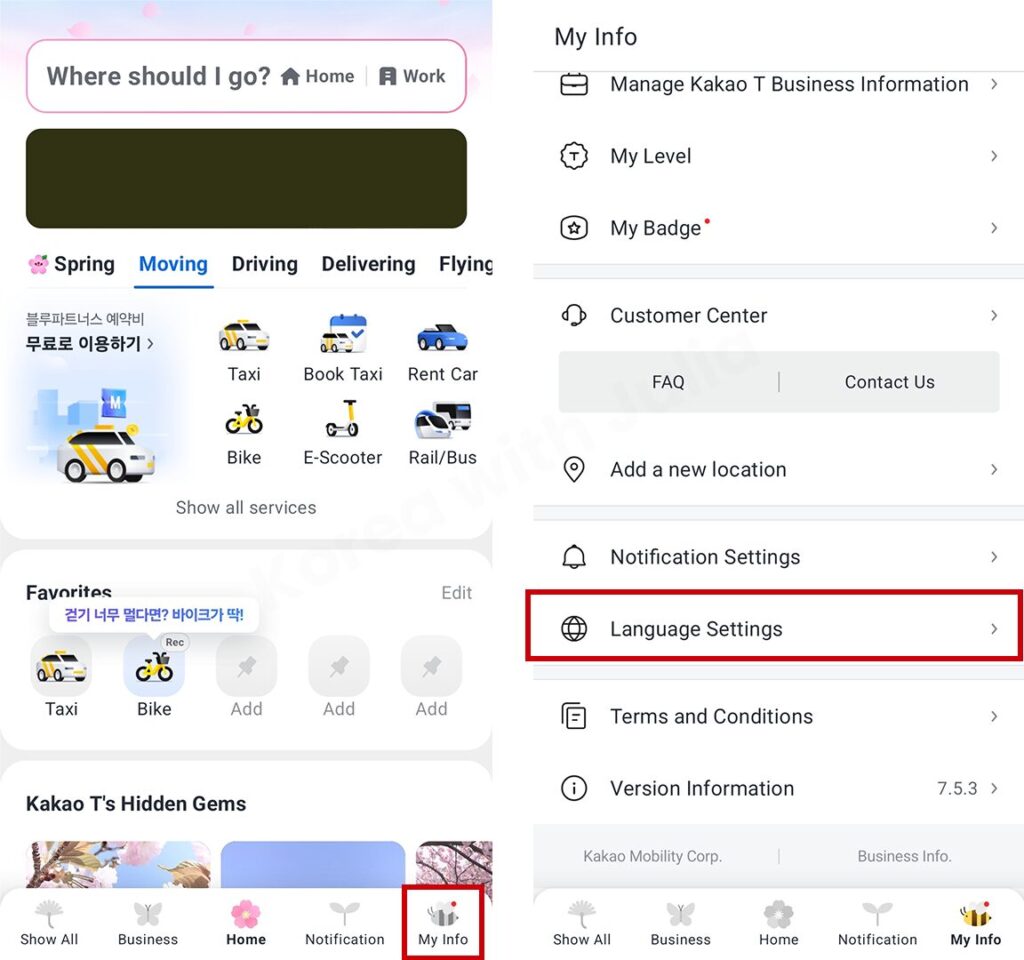
Kakao T supports Korean, English, and Japanese.
In most cases, it automatically matches your phone’s system language.
If not, you can change it manually in the settings.
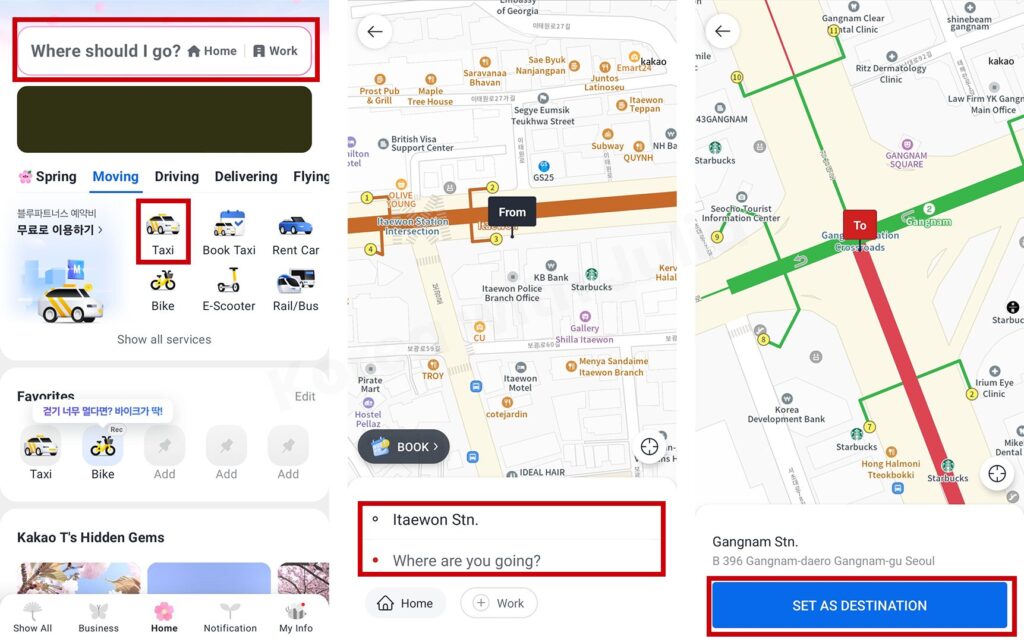
Although Kakao T offers many services, we’ll focus only on calling a taxi here.
- Tap Taxi under the Moving tab, or search for your destination at the top
- You’ll see the pickup and drop-off settings.
For example, let’s say you’re going from Itaewon Station to Gangnam Station.
- Enter the locations manually, or move the map to set your pickup / drop-off point.
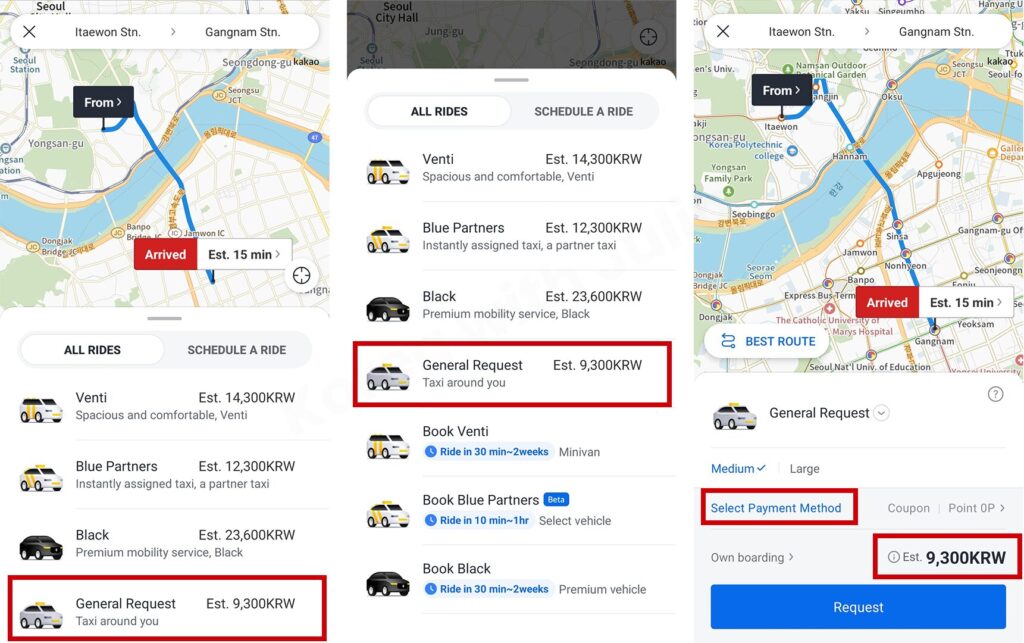
- Once your destination is set, you’ll see estimated time and fare.
- In most cases, you can simply select “General Request.”
If you need a faster ride or a larger / premium vehicle, you can choose:
- Blue Partners
- Black
- Venti
After selecting General Request, you’ll see the estimated fare.
This is only an estimate—actual cost may vary slightly depending on traffic.
- Choose your payment method and tap Request to call a taxi.
Things to Keep in Mind When Using Kakao T
You can either register your card in advance or pay the driver directly after the ride.
If you register a card, you might see a temporary hold when requesting a taxi—this is just a verification step.
After the ride, the driver inputs the final fare, and that amount will be charged.
In rare cases, some drivers may overcharge, so it’s a good idea to check the meter before you arrive.
The meter is usually located near the center console, around the AC controls.
Also, like Uber, Kakao T provides the route to both you and the driver—so you can easily check whether the driver is taking the correct route.
Alternative to Kakao T: k.ride
If you’re only visiting Korea for a short time, creating a Kakao account might feel inconvenient.
In that case, I recommend trying k.ride.
k.ride is a taxi app launched by Kakao Mobility specifically for foreign users.
In simple terms, it allows you to use Kakao T without needing a Kakao account.
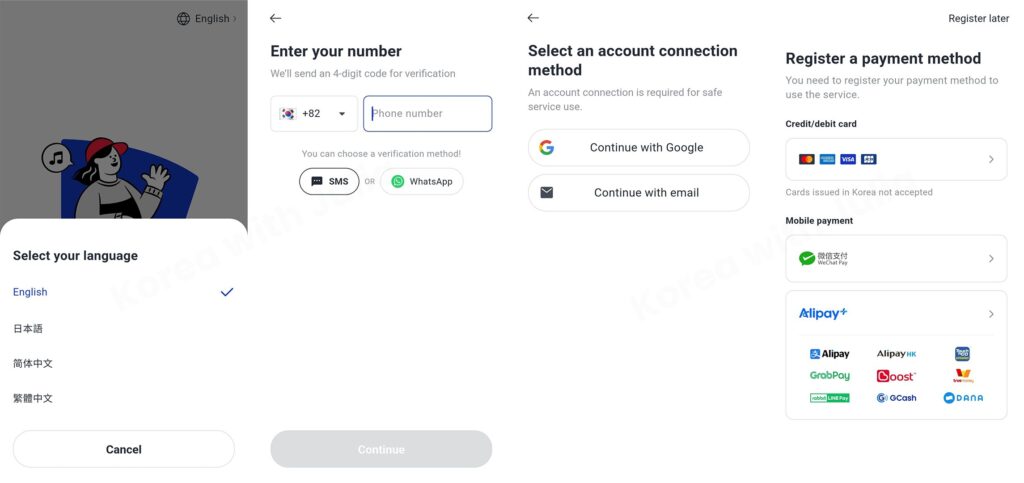
As shown above, k.ride supports English, Japanese, and Chinese (Simplified and Traditional).
According to Kakao Mobility, it also offers automatic translation in over 100 languages for destination search and chat with drivers.
You can verify your account using a phone number from your home country, and sign up using a Google account or email.
For payments, it supports credit cards and mobile payment services like Alipay.
I hope this guide helps you travel around Korea more easily using taxis!
If you have any questions or need help, feel free to leave a comment or send me an email—I’ll get back to you directly by email! 🚕
Leave a Reply